
Shabdakunja Eid Issues-2026
A Symphony of Integrated Dualities:
Bilal Al Masri's " Because of You" as a Manifestation Of Grand Poetry
By Cao Shui(China)
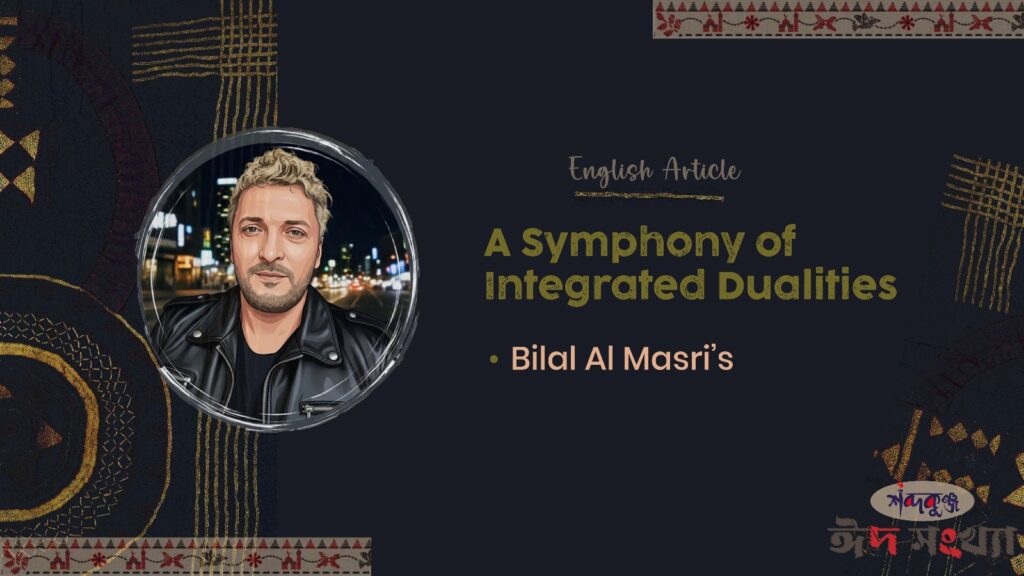
A Symphony of Integrated Dualities:
Bilal Al Masri’s “Because of
You”
as a Manifestation of Grand Poetry
By Cao Shui(China)
Founder of the Poetry Movement, Asia Coordinator of the World Poetry Movement, China Coordinator of the BRICS Writers Association, and Chairman of Beijing International Poetry Film Festival.
In the landscape of
contemporary world poetry, Bilal Al Masri’s “Because of You” emerges
as a luminous testament to the power of cultural and existential integration—a
core tenet of the Grand Poetry Movement I advocate. Translated from Arabic by
Dr. Anba Jawi MBE and Dr. Mohamad Haj Mohamad, this collection transcends
linguistic and geographical boundaries, embodying the movement’s ideals of
unifying Eastern and Western cultures, bridging ancient and modern
sensibilities, and reconciling the sacred and the secular. Through his searing
imagery and paradoxical insights, Masri crafts a poetic universe where
contradictions coexist, inviting readers to witness the beauty of a world stitched
together by shared humanity.
The integration of Eastern
and Western cultural traditions is a defining strength of Masri’s work. Rooted
in the rich poetic heritage of the Arab world—with echoes of Sufi mysticism and
the stark realism of war-torn Lebanon—his verses simultaneously engage with
Western literary traditions, from existentialist philosophy to modernist
experimentation. In “Jasmine rises like bullets,” Masri merges the
Eastern symbolism of jasmine as a symbol of purity with the Western metaphor of
bullets as instruments of destruction, creating a jarring yet profound image
that transcends cultural divides. Lines like “Bread resembles a
stab-wound” evoke both the biblical imagery of bread as sustenance and the
harsh reality of violence in the Middle East, blending two cultural frameworks
to articulate a universal truth about suffering and survival. The translators’
meticulous work preserves this duality, ensuring that the Arabic original’s
rhythmic cadence and the English language’s precision complement each other—a
harmonious fusion that mirrors the Grand Poetry Movement’s vision of cultural
synthesis.
Masri’s poetry also
masterfully integrates ancient and modern sensibilities, breathing new life
into timeless themes while confronting the crises of the contemporary world.
His exploration of life, death, and existence echoes the philosophical
inquiries of ancient Greek thinkers and medieval Sufi poets, yet his voice is
distinctly modern, shaped by the trauma of war and the alienation of modernity.
In “Darkness,” he writes, “It’s hard to totally erase the dark.
Were you to draw a thousand suns you wouldn’t banish darkness,” a
sentiment that resonates with both the ancient wisdom of Ecclesiastes and the
existential despair of 20th-century writers. Similarly, “The Path”
reimagines the ancient metaphor of the spiritual journey through the lens of
modern displacement, as strangers walk a desert guided by conflicting stars—an
echo of both Sufi pilgrimage and the refugee experience of the 21st century. By
weaving ancient symbols into modern narratives, Masri demonstrates that the
human condition is timeless, and that contemporary poetry can draw strength
from the depths of historical consciousness.
Perhaps most striking is
Masri’s integration of the sacred and the secular, as he blurs the lines
between the spiritual and the mundane to reveal transcendence in the most
unlikely places. In “My Mother,” he elevates the secular bond of
maternal love to a sacred realm, describing her silence as “a boat”
and the sea as “a drop upon her palm”—images that evoke both the
intimacy of family life and the cosmic mystery of divine presence. “I love
you” challenges the secular arrogance of modern science, declaring that
love’s light is the true path to salvation, while also affirming the sanctity
of all living beings: “Each creature has a beating heart. We’re at the
heart of Life bearing love’s pulse within, both I and you.” Masri does not
shy away from the profane—his poetry is filled with the grit of war, poverty, and
human failure—but he transforms these secular struggles into sacred acts of
resistance. In “Please Be Cherishing,” he calls for compassion toward
war-orphaned children, framing ordinary kindness as a holy duty that transcends
religious and ideological divides. This synthesis of the sacred and the secular
aligns with the Grand Poetry Movement’s belief that poetry should be both a
reflection of everyday life and a gateway to transcendence.
In “Because of
You,” Bilal Al Masri has created more than a collection of poems—he has
crafted a universal hymn to the human spirit. Through his integration of
Eastern and Western cultures, ancient and modern sensibilities, and the sacred
and the secular, he embodies the essence of Grand Poetry, proving that poetry
can be a unifying force in a fragmented world. His verses remind us that,
despite our differences, we share a common humanity shaped by love and loss,
hope and dream.